How to use the DOVE Competency Framework?
Key Terms
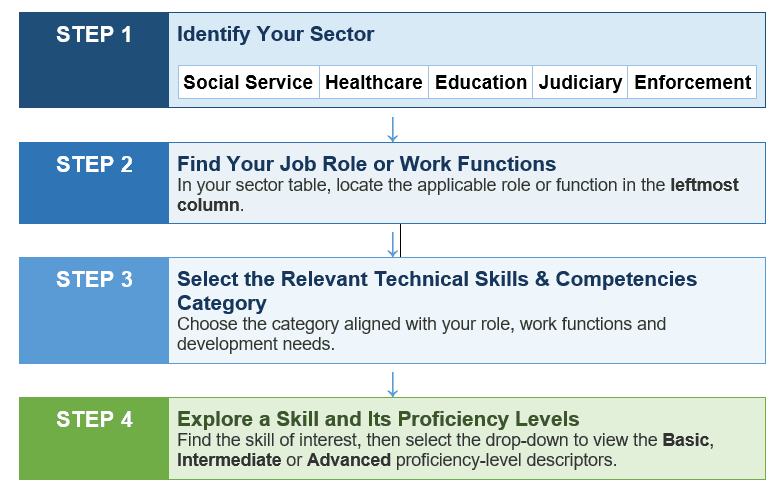
In this framework, the terms “Job Roles”, “Work Functions”, “Proficiency Levels” and “Technical Skills & Competencies Categories” will be used.
Job roles
Refer to the titles of DV practitioners (e.g., frontline first responders, nurses, caseworkers, counsellors and agency heads).
Work functions
Describe the areas of DV work that DV practitioners in certain job roles may be involved in
Technical Skills & Competencies (TSC) Categories
The categories refer to the broad area of work (e.g., casework, therapeutic intervention, care services) that the competencies cover. Within each category, the DV relevant skills are stated for each proficiency level.
Proficiency levels
Reflect increasing depth and scope of competency and may correspond to different roles and responsibilities across sectors.
This level typically includes staff whose core work does not involve the management of DV cases, as well as junior staff who support the management of DV cases, and who apply established DV tools, protocols and procedures, with guidance, to support safe and trauma-informed direct practice and achieve expected practice outcomes for survivors, children and other affected family members.
This level typically includes senior staff whose core work involves the management of complex DV cases, and who draw on deeper technical knowledge and problem-solving skills to adapt to changing contexts, while providing guidance to others to achieve expected practice and organisational outcomes.
This level typically includes staff whose core work involves establishing standards, systems and governance for DV practice, who draw on broader and deeper expertise across non-routine contexts to adapt, modify or customise the application of DV knowledge and skills, while driving capability strategy, sector or agency alignment, and extraordinary practice and organisational outcomes.
Step-By-Step Guide
Last updated on 14 September 2026